
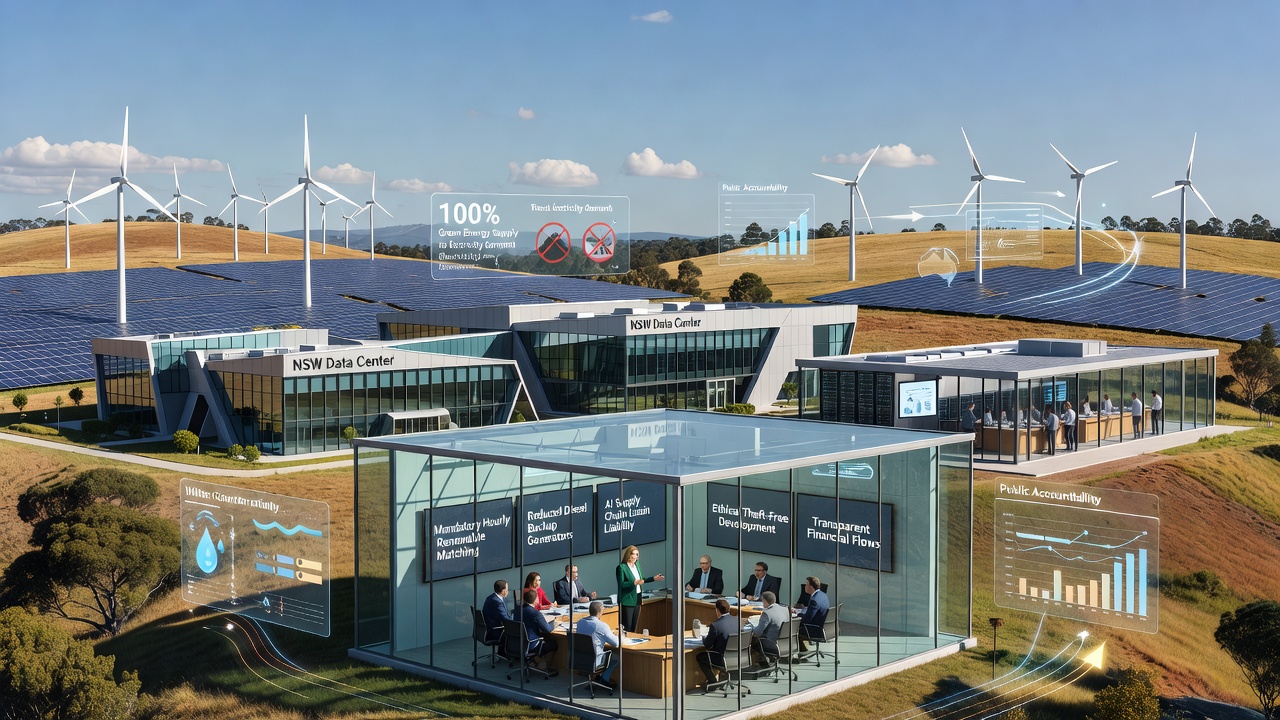
A New South Wales Upper House committee has recommended sweeping new obligations for data centers and the artificial intelligence systems they host, after concluding that the state's current voluntary guidelines fail to address energy, water and accountability concerns. The Public Accountability and Works Committee tabled 26 findings and 23 recommendations following its inquiry, though several stronger proposals were removed when the Labor and Liberal parties aligned to narrow the final report.
Hourly renewable supply requirement
The surviving recommendations still mark a notable shift in how Australian regulators might treat data center energy demand. Chief among them is a proposal that all data center electricity use be legally required to be matched by 100 percent renewable generation on an hourly basis, rather than through annual offset arrangements that are common in the industry today. The committee also called for reduced reliance on diesel backup generators and tighter reporting requirements so regulators and the public can track actual resource consumption rather than relying on operator-supplied estimates.
Committee chair Abigail Boyd, a Greens MLC, argued that the existing non-binding guidelines underestimate the renewable capacity needed to run facilities continuously, citing an industry estimate that every additional gigawatt of data center demand may require three to four gigawatts of new renewable capacity to ensure round-the-clock supply. Without binding hourly matching, she said, roughly a fifth of demand would likely be drawn from the existing grid, including coal and gas generation.
Liability and transparency across the AI supply chain
Beyond energy policy, the report recommends that NSW explore attaching legal and financial liability to AI models at every stage of development, extending down to the data centers that host and train them. It also proposes regulatory requirements to make financial flows more transparent, including disclosure of where profits are directed and how much value stays in Australia versus flowing to multinational parent companies.
Other recommendations urge the state government to intervene in how AI systems are built by requiring data center tenants and operators to support only "theft-free and ethical" development practices, and to improve access to computing resources for research and public-benefit projects. The committee additionally recommended that NSW lobby the Commonwealth government to strengthen, rather than weaken, national copyright protections on behalf of creators and rights holders.
What happens next
These are committee recommendations, not enacted law, and would require action from the NSW government and in some cases the federal government to take effect. Boyd has called for a moratorium on new AI data center approvals pending stronger rules, a position that goes further than what the final report's negotiated recommendations reflect. The report nonetheless signals growing scrutiny in Australia over the environmental footprint and governance of the data center buildout driving the current AI expansion.