
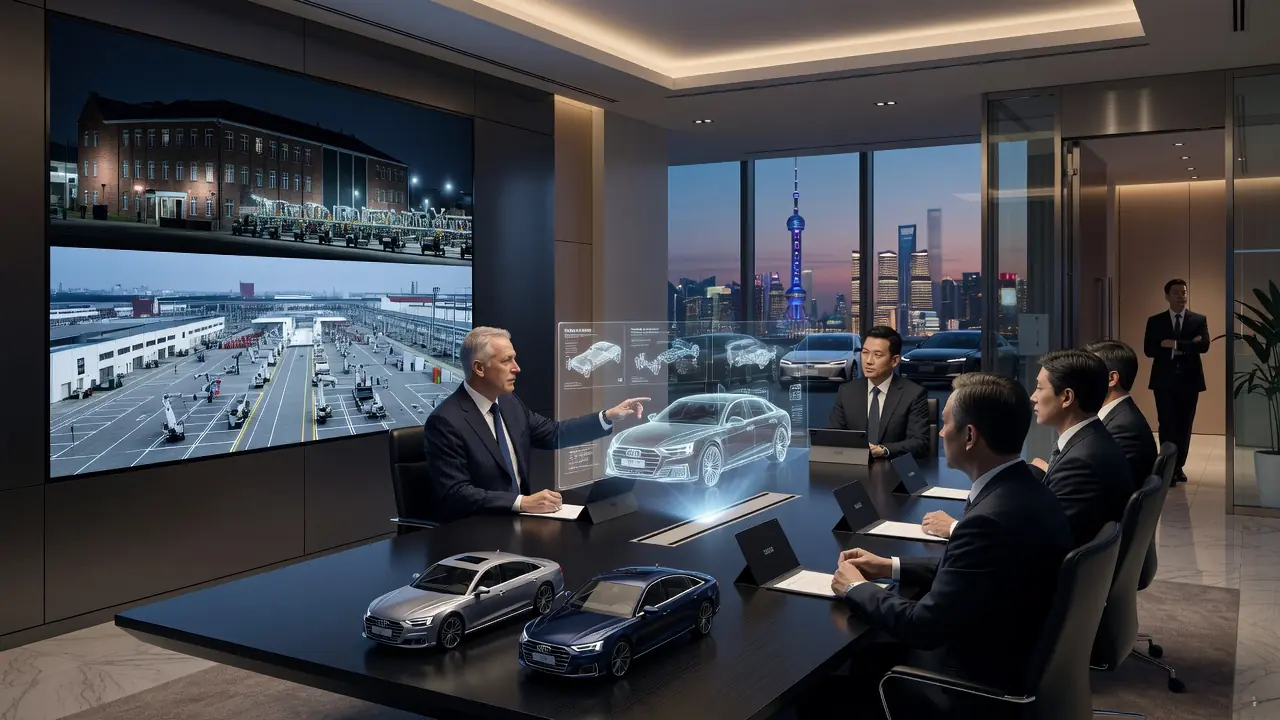
German magazine Manager Magazin reports that Audi's global CEO Gernot Döllner is in talks with Huawei to build the next-generation China-market A8 on a Huawei-based vehicle architecture, manufactured locally in Changchun instead of imported from Germany. The proposal is expected to reach Volkswagen Group's leadership for discussion this November, though it remains unconfirmed and faces internal resistance.
What the plan reportedly involves
According to the report, the next-generation Audi A8 sold internationally would shift away from its current platform to Porsche's MSB architecture, with production moving from Audi's 34-year-old Neckarsulm plant to Porsche's Leipzig facility, alongside the next-generation Panamera. Separately, the China-market A8 would take a different path entirely - built on Huawei's architecture at a domestic plant. If both changes proceed, the Chinese and German versions of the A8 would no longer share an origin or, reportedly, a comparable product experience. Döllner has also floated extending Huawei-based architecture to additional Audi models built in Changchun, though this remains a longer-term idea rather than a confirmed roadmap.
Why Audi is reportedly considering the move
The report ties this strategic review to mounting financial pressure. Volkswagen's finance department reportedly issued a profitability warning on Audi in late September. Audi's global sales fell 7.2% year-over-year in the first half of the year to 736,900 units, with net profit attributable to shareholders down 16.6% to 1.123 billion euros. Internal forecasts cited in the report put full-year global sales near 1.4 million units - the lowest in 15 years - with China sales projected to drop roughly 30% in 2026 to about 420,000 units.
Within China, demand for imported models like the A8 and RS line has reportedly stalled, while Audi's electric vehicles built on the PPE platform have underperformed: the Q6L e-tron averaged just 527 units a month from January through September, and the A6L e-tron has not surpassed 1,000 cumulative units since its April launch. Audi has already cut Neckarsulm's annual capacity to 225,000 units and ended night shifts, and shifting A8 production could further reduce costs while improving utilization at the underused Changchun plant, which has a planned capacity of 150,000 units.
Huawei's track record and the risks involved
The report notes that a jointly developed Audi brand built with SAIC on SAIC's own electric-vehicle technology has shown stronger results, particularly after the launch of its second model, the AUDI E7X - a factor said to have influenced Döllner's thinking. Huawei's involvement in brands such as AITO and Zhijie has similarly demonstrated its ability to support premium positioning in China's market.
Still, critics inside Volkswagen reportedly warn that adopting Huawei's underlying vehicle architecture is a far deeper commitment than simply integrating Huawei's software, and could dilute Audi's brand identity and engineering character. Nothing has been finalized, and the proposal's fate depends on the November discussion among Volkswagen's leadership.
Leadership change adds context
Separately, Audi China will appoint Zhang Jun as its first Chinese president, effective November 1. Zhang previously held a senior Audi China role from 2018 to 2020 helping build the SAIC Audi sales team, later serving as Vice President of Chery International and in executive roles at Stellantis China and Nissan. His appointment, alongside the reported Huawei discussions, reflects Audi's broader push to deepen its ties to the Chinese market, even as the architecture proposal itself remains unresolved.