
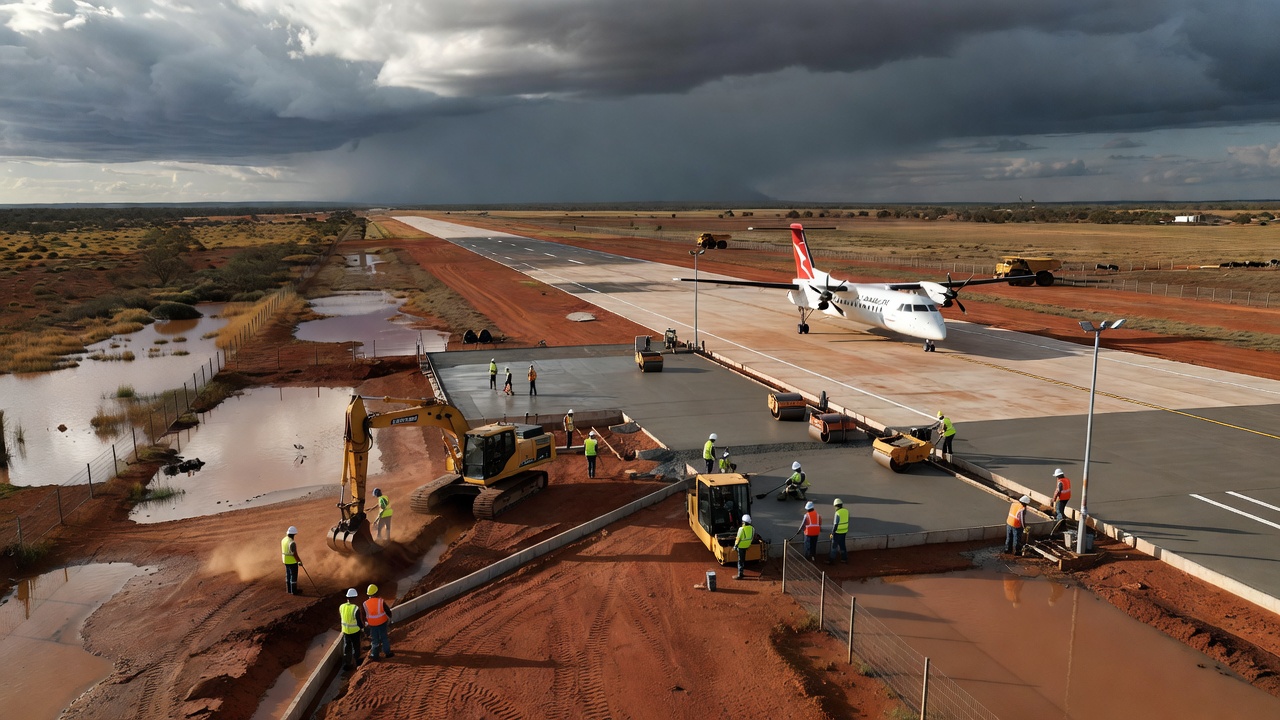
Cloncurry Shire Council in north west Queensland has received $10 million in federal funding to finish repairs to its airport, closing out a two-year effort to fully restore a transport hub that doubles as the region's lifeline when roads and rail lines flood. Prime Minister Anthony Albanese announced the funding on October 23, adding to $11.5 million already spent on emergency disaster recovery work after extreme weather damaged the airport in December 2025 and January 2026.
What the Funding Covers
The new money is earmarked for renewals and upgrades across the airport's core infrastructure: runways, taxiways, aprons, lighting, drainage and electrical systems. These are the components that determine whether an airstrip can keep operating safely through heavy rain and flooding, rather than just the visible surface of the runway itself. Drainage and electrical upgrades in particular are designed to prevent the kind of damage that forced emergency repairs after the last wet season.
Cloncurry mayor Greg Campbell said council had been "ready to go" with the work since July, and that construction has already begun with a contractor engaged ahead of the funding announcement. He described the combined $21.5 million package as enabling "the full scope" of resilience work, rather than a partial fix that might leave the airport vulnerable to the next major storm.
Why an Airport Matters During Floods
Cloncurry's isolation during wet weather is the central reason this project carries weight beyond routine infrastructure maintenance. Cr Campbell pointed to flooding in 2019 and earlier this year, when both the highway and rail line into the shire were cut, leaving air transport as the only way in or out while the roads were impassable. When the airport itself went out of action during this year's storms, the town briefly lost all three transport links at once.
That scenario underlines why the funding is described as a resilience measure rather than a cosmetic upgrade. Cr Campbell was careful to frame the limits of what the work can achieve: "If the next weather event is the equivalent of what we've seen before we will be okay. If it's something we haven't seen before, that's quite a different story." In other words, the upgraded infrastructure is built to withstand the worst conditions on record, not an unprecedented event beyond that benchmark.
Broader Context for Queensland Councils
Treasurer Jim Chalmers linked the project to the regional economy, noting that Cloncurry functions as a corridor for mining, agriculture and resources activity across north Queensland. Local Government Association of Queensland president Matt Burnett credited sustained advocacy from Cr Campbell for the outcome, while LGAQ chief executive Alison Smith said the result would encourage other councils pursuing similar "betterment" funding.
The Cloncurry grant is part of $24.5 million announced on October 23 under the federal Disaster Ready Fund, which also supports projects in the Proserpine River catchment and the Fraser Coast. It follows the federal government's decision to retain its disaster recovery funding contribution at up to 75 percent, a threshold Queensland councils had lobbied to preserve. Delegates at the LGAQ's recent annual conference in Cairns also backed a motion pushing for guaranteed funding for larger resilience projects and for embedding betterment principles into future disaster recovery planning.